


How the Iran Conflict Is Driving Real Time Costs on Main Street
The global tension stemming from the conflict involving Iran is reaching businesses from Wall Street to Main Street — but not in the same ways. With the S&P 500 ending April up 10 percent, its best monthly performance since 2020, large corporations continue to show resilience, buoyed by scale, pricing power, and access to capital.
The picture on Main Street looks more complicated. Small business owners are navigating a delicate economic moment, benefiting from productivity gains driven by emerging technologies like AI while also contending with cautious consumer spending and rising operating costs. As the price of Brent crude climbs, many Main Street businesses are watching higher fuel, energy, and transportation costs flow through their operations in real time.
BizBuySell’s latest quarterly Insight Report, which surveys small business owners across the U.S., finds that more than 70% report their operations have been affected by the U.S.–Iran conflict. The most frequently cited impacts are higher fuel and energy costs, followed by increased shipping expenses and delivery delays — suggesting that while global tensions may feel distant, their economic effects are reaching small businesses less through direct disruptions and more through higher day‑to‑day operating costs.
Despite these headwinds, small business owners continue to demonstrate resilience. But the data suggest that while financial markets may be pricing in stability, Main Street remains on the front lines of global uncertainty — absorbing those costs as they move through the economy.
Inflation Sentiment: Relief Gives Way to Uncertainty
As inflation accelerated in the wake of pandemic-era relief efforts, BizBuySell has tracked how small business owners perceive its impact on their operations. Sentiment began to show signs of improvement in mid-2024, as some owners reported easing price pressures. Since then, however, confidence has leveled off amid renewed uncertainty tied to trade policy debates and rising energy costs.
By early 2026, uncertainty had become a defining feature of inflation sentiment. For the first time in three years, the share of respondents who said they were unsure whether inflation was easing surpassed those who believed it was improving. Uncertainty overtook optimism as the share of “unsure” responses jumped more than 60% between late 2025 and Q1 2026. Several business owners said inflation had appeared to ease earlier, but recent increases in fuel and energy prices — especially higher gas costs — have made it harder to tell whether relief is actually sticking.
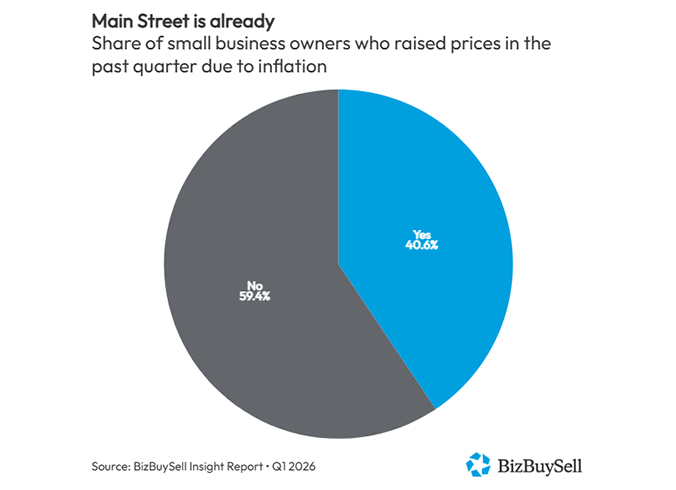
That uncertainty is showing up in pricing behavior. Despite roughly three-quarters of business owners reporting higher expenses in Q1 2026, the majority say they have not raised prices in the past quarter. Fifty-nine percent report holding prices steady for now, often citing competitiveness or customer sensitivity, while others say price increases are being considered but deferred.
Among the 41% of owners who have raised prices, the most common driver is higher costs passed down through the supply chain, especially transportation and logistics fees. Meanwhile, owners reluctant to raise prices report cutting costs elsewhere to absorb inflationary pressures. As one business owner put it, previous price increases were not well received by customers, leaving the business to absorb higher costs rather than risk losing demand.
How the Iran Conflict Is Affecting Small Business Operations
Not all small businesses are feeling the effects of the U.S.–Iran conflict in the same ways. In BizBuySell’s Insight Report survey, 23% of small business owners said the conflict has not affected their operations, while another 26% said it is still too early to assess the impact. That divergence reflects how unevenly global tensions translate into day-to-day business conditions across sectors.
For those closer to the supply-chain front lines, however, the effects are clearer. More than half of business owners cite higher fuel and energy costs as affecting their operations. Nearly 20% report increased shipping costs or delays, 15% are experiencing supply-chain disruptions for imported goods and materials, and 11% report higher insurance or risk-management costs. While businesses in transportation-dependent sectors such as trucking, food service, and hospitality face the most direct exposure, even businesses less exposed to fuel and shipping costs are not immune to rising energy prices, which affect everything from office overhead to client behavior.
Even among businesses that are not directly impacted by fuel or shipping costs, broader uncertainty is weighing on decision-making. Some owners noted reduced investment activity and slower startup funding tied to global instability, while others pointed to operational strains such as longer insurance claim timelines, stretching from roughly 30 days to 120 days or more. For businesses that may feel insulated from global conflict, uncertainty among customers and clients can still ripple back to Main Street — delaying investments, slowing growth plans, and reinforcing a more cautious operating environment.
Energy Costs and Rising Expenses Are Pressuring Margins
Energy costs are a line item for virtually every business, and recent increases are showing up directly in profitability. More than half of small business owners report that higher fuel and energy costs are having a moderate or significant impact on their margins. Several respondents noted that these increases extend beyond fuel, pointing to higher utility expenses such as electricity, water, and waste services — costs that are becoming harder to absorb for businesses operating on thin margins.
Rising energy costs are part of a broader expense squeeze. Seventy-five percent of business owners report that overall expenses have increased over the past year. When asked which costs were driving those increases, cost of goods sold ranked highest, cited by 64% of respondents, followed by fuel and energy, insurance, marketing, payroll, and equipment costs. Notably, real estate and debt service were cited less often, suggesting today’s pressure is coming more from variable operating expenses than from fixed financing obligations.
Taken together, the findings point to a growing disconnect between headline economic strength and the day-to-day reality facing small businesses. While markets may be signaling confidence, Main Street is operating in a more uncertain environment — one shaped by rising energy costs, uneven inflation relief, and global tensions that are filtering through operating expenses rather than balance sheets. For small business owners, resilience increasingly means managing volatility, not escaping it.