


AI Goes Mainstream on Main Street: 2 in 3 Small Businesses Now Use It — and 83% See Results
OpenAI released ChatGPT in late 2022, and in just over three years, generative artificial intelligence has become the fastest-adopted technology in history. What started as an early chatbot demo has evolved rapidly, with models like Anthropic’s Mythos now considered so powerful that the company has chosen not to release it widely.
As users grow more comfortable with AI tools and corporate mandates to adopt AI accelerate, small businesses are increasingly incorporating AI into their workflows as well. AI is no longer experimental; it’s mainstream. Especially on Main Street.
BizBuySell’s quarterly Insight Report surveyed business owners and entrepreneurs about a wide range of issues, including artificial intelligence. Nearly 2 in 3 small businesses are using AI, and 83% report measurable performance gains.
As Main Street businesses grapple with economic headwinds — from rising inflation and labor shortages to higher operating costs driven by energy price spikes tied to the conflict in Iran and the Strait of Hormuz — AI’s productivity boost is helping offset margin pressure and workforce challenges.
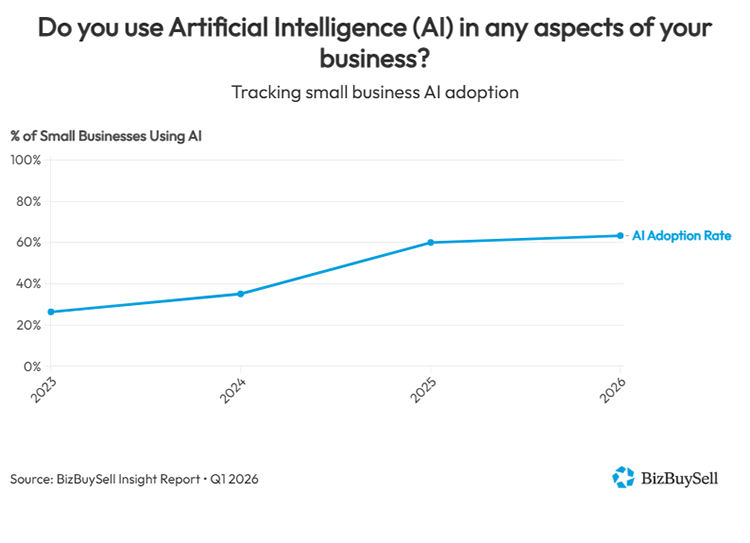
AI Adoption Has Nearly Tripled Since 2023
BizBuySell first began asking business owners and entrepreneurs about their AI use in 2023. In our Q1 2023 survey, just over one in four business owners reported using AI.
Adoption levels spiked in Q1 2025, when 60% of respondents indicated they were using AI, a 127% increase from 2023. Since then, adoption has continued to rise, though at a slower pace, with year-over-year gains of roughly 6% in 2026.
The data points to a clear inflection moment: 2025 marked the year AI crossed from experimentation into mainstream adoption for small businesses.
Productivity and Automation Drive AI Use
From generative to agentic artificial intelligence, Main Street business owners are finding platforms that support nearly every aspect of their operations. Overwhelmingly, productivity is the primary motivation for adoption.
Seventy-eight percent of survey respondents cite productivity gains as their top reason for using AI, followed by analysis and insights (60%) and automating routine tasks (56%), which represents a 94% increase in automation-focused use over two years.
For small businesses, 85% of which have 10 or fewer employees, AI provides leverage. It allows lean teams to accomplish more without proportional increases in headcount or overhead. For many, improving efficiency now takes priority over reducing costs (46%), gaining a competitive advantage (46%), or improving customer service (35%).
How Small Businesses Are Using AI: From Marketing to Analytics
When asked how they are using AI, 77% of owners reported leaning on AI for marketing. From social media posts and document drafting to brainstorming and idea generation, marketing remains the most common entry point.
Fifty-six percent of owners are using AI for analytics, while 42% are using AI for search and research. From simple queries to more complex information gathering, AI-driven search is becoming increasingly common, up from 21% in Q1 2024.
ChatGPT Dominates, But the AI Stack is Diversifying
Tool preferences are consolidating around a few major platforms. ChatGPT leads decisively at 82%, followed by Google Gemini (50%), Claude (39%), Microsoft Copilot (25%), and Grok (18%). This consolidation signals market maturity, as business owners are converging on proven, reliable tools rather than experimenting with dozens of options.
AI-assisted tools like Canva AI and Grammarly AI are also in heavy rotation, helping business owners with creative tasks such as design and writing. Among write-in responses, many owners cited Marblism, a platform that allows users to build AI “teams” to manage social media, SEO, lead generation, calls and customer support.
As business owners increasingly rely on AI platforms to grow and scale their business, they are reducing key-person risk, or owner dependency. Offloading tasks and responsibilities to AI systems helps create more transferable, less owner-dependent businesses.
AI Is a Budget Line Item, and 7 in 10 Owners Are Paying for It
AI is no longer a nice-to-have experiment, it's becoming a recurring budget line item. Seventy percent of business owners are paying for AI tools, either through fully paid subscriptions or a mix of free and paid plans. This investment underscores a shift: AI is viewed as a tool to improve productivity and performance, not just a cost to manage.
At the same time, 75% of owners report business expenses increasing in the first quarter of the year, with 64% citing cost of goods as the primary driver. Technology and AI subscriptions add to operating expenses, whether through small token purchases or annual subscriptions.
With over half of owners reporting decreased consumer spending over the past three months, business owners are carefully weighing increased costs amid an uncertain economic environment.
AI is Augmenting Work, Not Replacing It
AI’s impact on the labor market has sparked debate among economists, from efficiency gains to universal basic income. On Main Street, however, the picture is far more nuanced.
While 57% of owners report that it is still not easier to hire or retain employees at a reasonable rate — consistent with prior years — small businesses remain eager to hire. AI is helping improve productivity, not replace workers.
Only 8% of owners report reducing roles as a direct result of AI adoption, while 6% report hiring due to AI-driven gains. With 69% of small business owners not reducing roles since adopting AI workflows, AI is primarily augmenting roles, rather than eliminating them.
Among the roles most commonly added are marketing and operations, reflecting where business needs remain strongest.
83% Report Performance Gains Tied to Efficiency and Speed
Main Street is navigating significant uncertainty from tariffs and energy costs to cautious consumer spending. As AI tools become more powerful and accessible, small business owners are increasingly turning to them to drive productivity.
Eighty-three percent say AI has improved business performance. Owners tell BizBuySell that AI allows them to cover more ground and get more done. One owner noted that while AI has improved their individual performance, its impact on overall business performance is still unfolding. A reminder that AI adoption is a process, not a switch.
The 83% reporting performance gains aren't seeing abstract, long-term benefits — they're experiencing efficiency and speed improvements in day-to-day operations. This reinforces that AI is no longer experimental; it's relied upon for delivering real, near-term value.
What This Means for the Business-For-Sale Market
While adoption is overwhelmingly positive, concerns remain. One in three owners report no concerns, while 35% cite data privacy and security as their top issue. Lack of knowledge (23%) and cost (23%) are also common challenges. Only 6% express concern about AI’s impact on the labor market.
So, what does this all mean for the business-for-sale market in 2026?
Business owners who adopt and adapt to AI platforms are better positioned when it comes to sell. With 76% of buyers believing that AI gives them the practical skills to successfully buy and run a business, even outside their areas of expertise, sellers would be wise to lean into AI.
Buyers are increasingly adding AI to their due diligence checklists, asking about a business’s AI stack, its impact on operations, and how transferable those systems are post-sale.