

Main Street’s Hiring Hesitation Echoes in National Job Revisions
On August 1st, the Bureau of Labor Statistics reported that the unemployment rate ticked up 0.1% to 4.2% in July. While July’s modest uptick drew some attention, it was the substantial downward revisions to May and June job gains that truly captured headlines, signaling a more pronounced softening in the labor market. Despite the slowdown, wage growth (3.9%) continues to outpace inflation (2.6%), suggesting a resilient consumer base that may still be propping up the broader economy.
The second quarter of 2025 marked the rollout of several ambitious economic policies under the new Trump administration, including changes to tariffs, trade and taxation. From Wall Street to Main Street, businesses scrambled to adapt to proposals that were enacted, amended, or paused in rapid succession. While national figures hinted at a cooling labor market, small business were already adjusting their expectations.
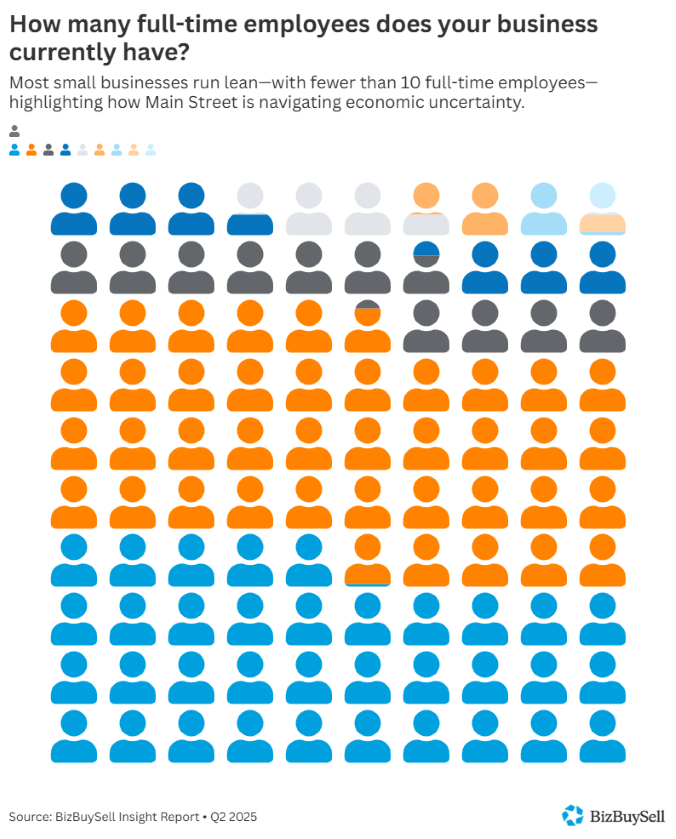
Small businesses entered 2025 with optimism: 90% of respondents to BizBuySell’s year-end Insight Report expressed confidence for the year ahead. But by Q2, optimism had cooled. A drop of over 11% in hiring sentiment suggests that Main Street was already bracing for economic headwinds, before national job data reflected the shift.
Small Business Hiring Sentiment
BizBuySell’s quarterly Insight Report, which tracks the health of the small business-for-sale market, surveyed business owners on a range of topics — from operational health to valuation and exit planning. In April 2025, optimism was strong: 43% of business owners anticipated hiring more employees to meet growing demand.
But after the April Liberation Day tariff announcements, which were implemented, paused, renegotiated and ultimately pushed to Q3, Main Street sentiment began to shift. By July, only 31.9% of business owners reported plans to hire more staff.
The share of owners anticipating no change in staffing rose to 62.7%, while those planning layoffs remained relatively steady at 5.4%. Many respondents described a strategy of holding tight and operating lean amid economic uncertainty.
“We want to maintain our current staff size and use AI help them be more productive and fulfilled in their roles.”
“I will likely let some employees attrit, and then give more hours to existing employees”
“I will be working more hours myself rather than paying employees.”
“I've already had to let good people go because business slowed so dramatically after the tariff announcements.”
Still, not all owners are pulling back. Some are expanding and hiring:
“Business is expanding rapidly. As we add to our locations, we’ll also be increasing staff.”
“We will maintain staff of acquired businesses and hire more as we scale.”
Staffing Strategy and Its Impact on Valuation
Hiring decisions are more than operational, they’re strategic. Especially when it comes to selling a business. As small business owners reassess staffing plans, many are also reevaluating their valuation expectations and exit timelines.
For buyers, a business with a trained team in place is far more attractive than one that requires them to step in and fill operational gaps. In fact, key person risk—where the business depends too heavily on the owner—can have a big impact on buyer interest and valuation. A lean team may signal efficiency, but if it comes at the cost of scalability or continuity, it can rais red flags during due diligence.
One business broker noted for the Q2 Insight Report, “The general business climate is uncertain because of the on-again, off-again tariffs. Most small businesses already had staffing issues, and the current environment has made this worse.”
In today’s business-for-sale market, staffing isn’t just about managing costs, it’s about presenting a business that’s ready to run without the owner. Whether holding steady or scaling up, owners should consider how their labor strategy supports their long-term goals and marketability.
From Hiring Sentiment to Exit Strategy
As the labor market softens and economic policies shift, small business owners are adjusting not just their hiring plans, but their long-term strategies. Businesses with stable teams in place are often attractive to buyers, who are looking for a business—not a job. Minimizing key person risk and having a team in place to handle operations and provide continuity make all the difference when it’s time to sell.
For owners considering an exit, explore BizBuySell’s Exit Planning Resources to learn how to position your business for a successful sale.