

Small Business AI Adoption Trends in 2025
The artificial intelligence landscape continues to make headlines in 2025, with Elon Musk and a consortium of investors recently bidding nearly $100 billion to buy control of OpenAI, the company behind ChatGPT. While OpenAI's CEO Sam Altman playfully rejected the offer from his former co-founder, the bid highlights the enormous value and competitive stakes in AI development. On the heels of the Artificial Intelligence Action Summit, businesses of all sizes are watching the AI race intensify – but perhaps none more carefully than small business owners, who are rapidly embracing AI tools to remain competitive.
The surge in AI adoption over the last eight years has been remarkable. According to Statista, the percentage of companies integrating AI into at least one business function has increased 72 percent. Generative AI, a type of AI that can create new content like text, images, videos and music, is being used by 65 percent of organizations worldwide. For small businesses in particular, AI has evolved from an emerging trend to an essential business tool.
The Rise of AI in Small Businesses
Small business AI adoption has seen remarkable growth according to BizBuySell's Insight Report, a nationally-recognized economic indicator tracking the U.S. small business economy. The quarterly survey reveals that AI adoption among small business owners nearly doubled over an 18-month period, jumping from 26 percent in Q2 2023 to 51 percent by Q4 2024. This increase means that just over half of small businesses now incorporate AI applications into their operations, while 49 percent have yet to adopt the technology. The acceleration in adoption rates is particularly noteworthy, with the percentage climbing from 35 percent at the start of 2024 to over 50 percent by year's end – signaling a shift in how Main Street conducts business.
How Small Businesses are Using AI Today
Marketing leads the way in small business AI adoption, with over 75 percent of surveyed owners reporting they use AI tools for marketing functions. Analytics and customer service follow as the next most common applications, reflecting small businesses' focus on growth and efficiency. The integration of AI into search capabilities emerged as a trend in late 2023, transforming how businesses research information and understand complex topics. Business owners are increasingly turning to AI for a variety of functions, from software development to social media strategy. However, adoption remains cautious in certain areas – particularly cybersecurity, which saw only modest growth from 6 percent to 7 percent over the 18-month period. This measured approach reflects small business owners' careful consideration of data security when implementing AI systems.
Why Small Businesses Are Embracing AI
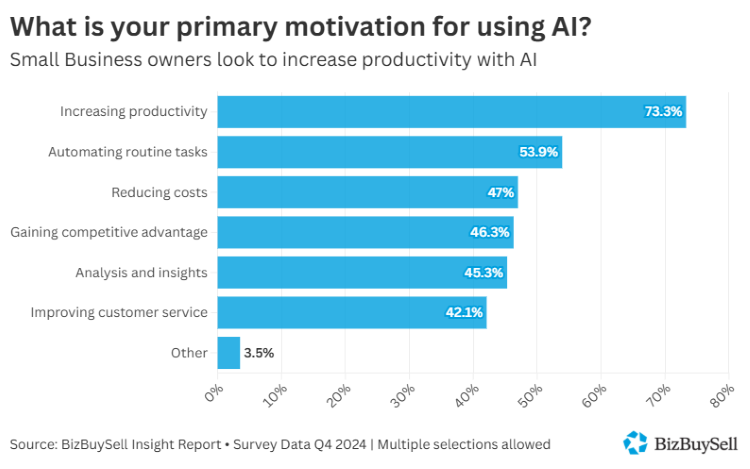
Over 70 percent of business owners surveyed at the beginning of 2024 reported that AI has improved their business's performance – a statistic driving continued adoption. As small business owners navigate challenges with inflation, labor shortages, and supply chain disruptions, AI offers practical solutions for maintaining and optimizing operations. Productivity enhancement leads the list of motivations for AI adoption, followed by task automation, cost reduction, and competitive advantage. While improving customer service remains important, businesses are primarily leveraging AI for operational efficiency and strategic insights.
The integration of AI into small business systems marks a shift in how companies operate. While adoption rates continue to climb, with over 50 percent of small businesses now leveraging AI tools, owners are taking a measured approach to implementation. Businesses are carefully weighing considerations around data privacy and accuracy while strategically introducing AI systems into their workflows. As the technology becomes increasingly accessible, its impact on business operations and valuation will likely deepen. Success in this evolving landscape will depend not just on adoption, but on thoughtful implementation that aligns with each business's specific needs.