


How Small Businesses Are Adapting to 2026 Tariffs
Tariffs are back in the headlines. At midnight on Friday, July 24, a new set of U.S. tariffs took effect, duties of 10% to 12.5% on roughly 60 trading partners. The new rates replaced a global tariff that expired at the same time. But as the New York Times' DealBook noted Friday morning, this round feels different in one important way: businesses saw it coming. Unlike the sudden policy shifts of 2025, this change did not catch business owners off guard. After more than a year of navigating an ever-changing trade landscape, many small business owners have learned to treat tariffs as a constant rather than a surprise, a shift reflected in our latest survey data.
To understand how tariffs are reaching Main Street, BizBuySell surveyed small business owners for its Q2 2026 Insight Report, which tracks the health of the U.S. small business economy. The results reveal a notable pattern: relatively few owners pay tariffs directly, yet many still feel their effects. Just under 11% reported paying tariffs directly last quarter, while 40.6% said they never paid them at all. Most owners fall somewhere in between, 36.4% of owners said that while they didn't pay tariffs directly, they still absorbed higher costs passed down from suppliers and vendors. As one owner put it, "Multiple subcontractors and suppliers blamed tariffs for price increases."
This indirect pressure is what matters most for Main Street. Even a business that imports nothing can see its costs rise when suppliers raise their prices, and that same pressure appears elsewhere in our Q2 data, where the rising cost of goods topped the list of factors driving business expenses higher. For the businesses feeling the biggest impact, some are pushing back. Within hours of the new tariffs taking effect, two small businesses filed a lawsuit challenging them in federal court.
What the Experts Are Watching
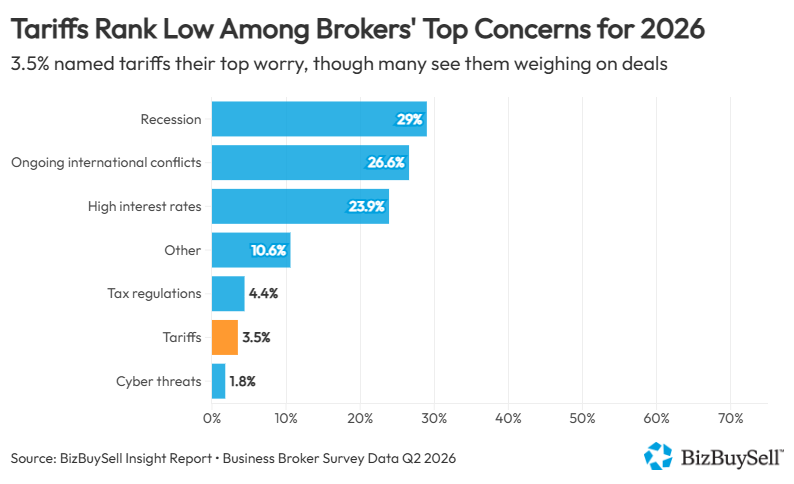
The brokers who facilitate business sales every day tend to have an early read on what worries Main Street, and tariffs are not at the top of their list. When BizBuySell asked brokers to name their top concern for the remainder of 2026, just 3.5% pointed to tariffs. Their greater concerns lie elsewhere: recession (29%), ongoing international conflicts (26.6%), and high interest rates (23.9%) ranked highest.
That low ranking does not mean tariffs have stopped affecting businesses, but rather that they have become a known factor. Brokers still see the effects firsthand. "I am coming across many businesses that are experiencing worsening financial conditions due to tariffs, inflation, etc.," one broker noted, while another observed that continued tariff uncertainty is making some buyers slower to commit. The difference is that after a turbulent 2025, tariffs have become a cost many businesses have learned to anticipate and manage.
For some businesses, that shift is even creating opportunity. As one broker put it, "Service businesses that are less impacted by tariffs and interest rates seem to be popular. A business that can make it in various economic environments, more recession-resistant than recession-proof, will also be in demand." The same uncertainty weighing on import-reliant businesses is making steady, service-oriented ones more appealing to buyers.
Looking Ahead
The trade landscape remains unpredictable, and the broader backdrop, from renewed conflict in the Middle East to a watchful Federal Reserve, adds to the uncertainty small business owners face. Even so, the through-line of our Q2 data is one of steady adjustment rather than alarm. Having navigated more than a year of shifting trade policy, many Main Street businesses have grown more informed, more nimble, and better prepared for what comes next.
For those buying or selling a business in today's market, the takeaway is much the same: stay informed, understand where tariff exposure actually lies, and recognize the lasting value of businesses built to adapt. As the BizBuySell Insight Report continues to show, resourcefulness and adaptability remain Main Street's greatest strengths.